The First Sentence: Draft Five, Record One
If you could only get one sentence right in a whole video, it should be the first one. Everything else you write is read by people who already decided to stay, and that decision is made before you have finished your first breath.
Most advice about openings arrives as a list of hook types. Useful, but it skips the part that actually changes the work: the first line is not something you think of, it is something you draft several times and choose between. This is the process I use for that, and the tests I run before one of them gets recorded.
What the first line is competing against
It helps to be precise about the situation. Your opening is not competing against other videos on the same subject. It is competing against a scroll — a thumb already in motion, a feed of alternatives one flick away, and a viewer who has not committed to anything.
People often say the first three seconds decide it. Treat that as a description of the pressure rather than a measurement; nobody can tell you the exact number, and the exact number does not change what you have to do. What matters is that the opening seconds carry a disproportionate share of the decision, and that a video losing people there never gets the chance to show anyone the good part.
Delete the greeting
The most common opening in the world is some version of “hi everyone, welcome back to the channel, today we’re going to talk about…”. It is polite, it is habitual, and it spends the most valuable seconds you have on information nobody needs.
At second one, a stranger does not care who you are. They care what this video has for them. The introduction is not banned — it is just in the wrong place. Move it after the first real content, if you keep it at all, and let the first line do work.
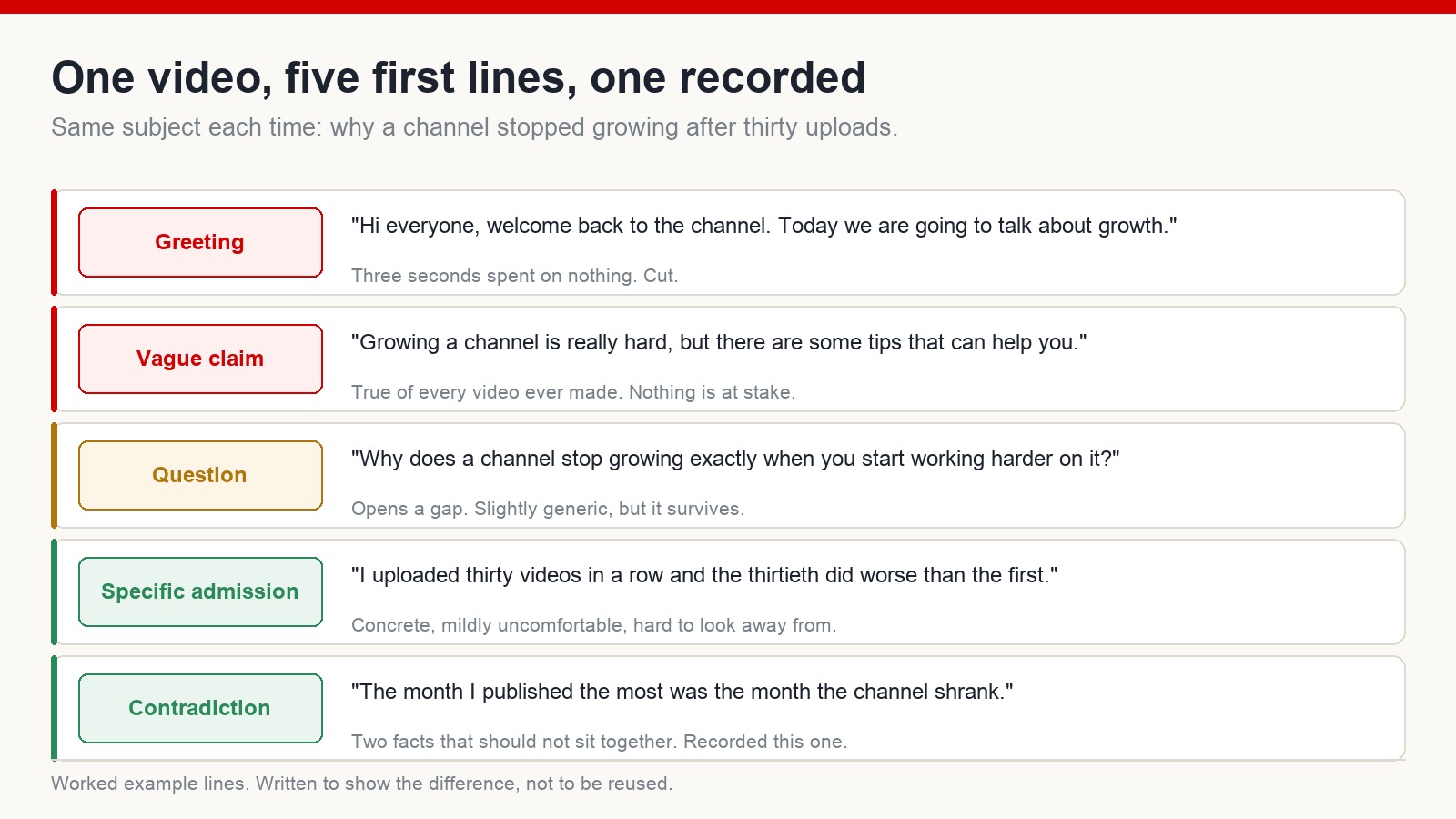
Draft five, record one
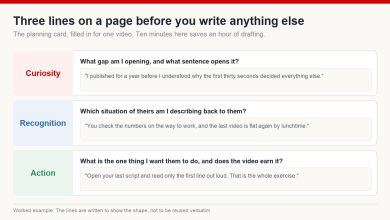
Here is the practical habit. For every video, write five first lines before you write anything else. Not five variations of the same sentence — five different attempts, deliberately unlike each other.
Take a video about why a channel stopped growing after thirty uploads. The greeting version is dead on arrival. A vague version — “growing a channel is hard, but there are tips that help” — is true of every video ever made and puts nothing at stake. A question version — “why does a channel stop growing exactly when you start working harder on it?” — opens a gap and survives, though it is a little generic. A specific admission — “I uploaded thirty videos in a row and the thirtieth did worse than the first” — is concrete and mildly uncomfortable, which makes it hard to look away from. And a contradiction — “the month I published the most was the month the channel shrank” — puts two facts side by side that should not sit together.
Written out next to each other, the choice is usually obvious. Written one at a time, you record the first thing you thought of, which is nearly always the third-best option.
The specificity test
The single most reliable way to separate a live first line from a dead one: could this sentence sit on somebody else’s video, unchanged?
“This tip will change everything” fits any video on earth. “I deleted one sentence from my intro and people stopped leaving at eight seconds” fits exactly one. Specificity is not decoration — it is what makes a claim believable and what makes a gap worth waiting to have closed. Vague superlatives do the opposite: audiences have heard them so often that they now read as a warning.
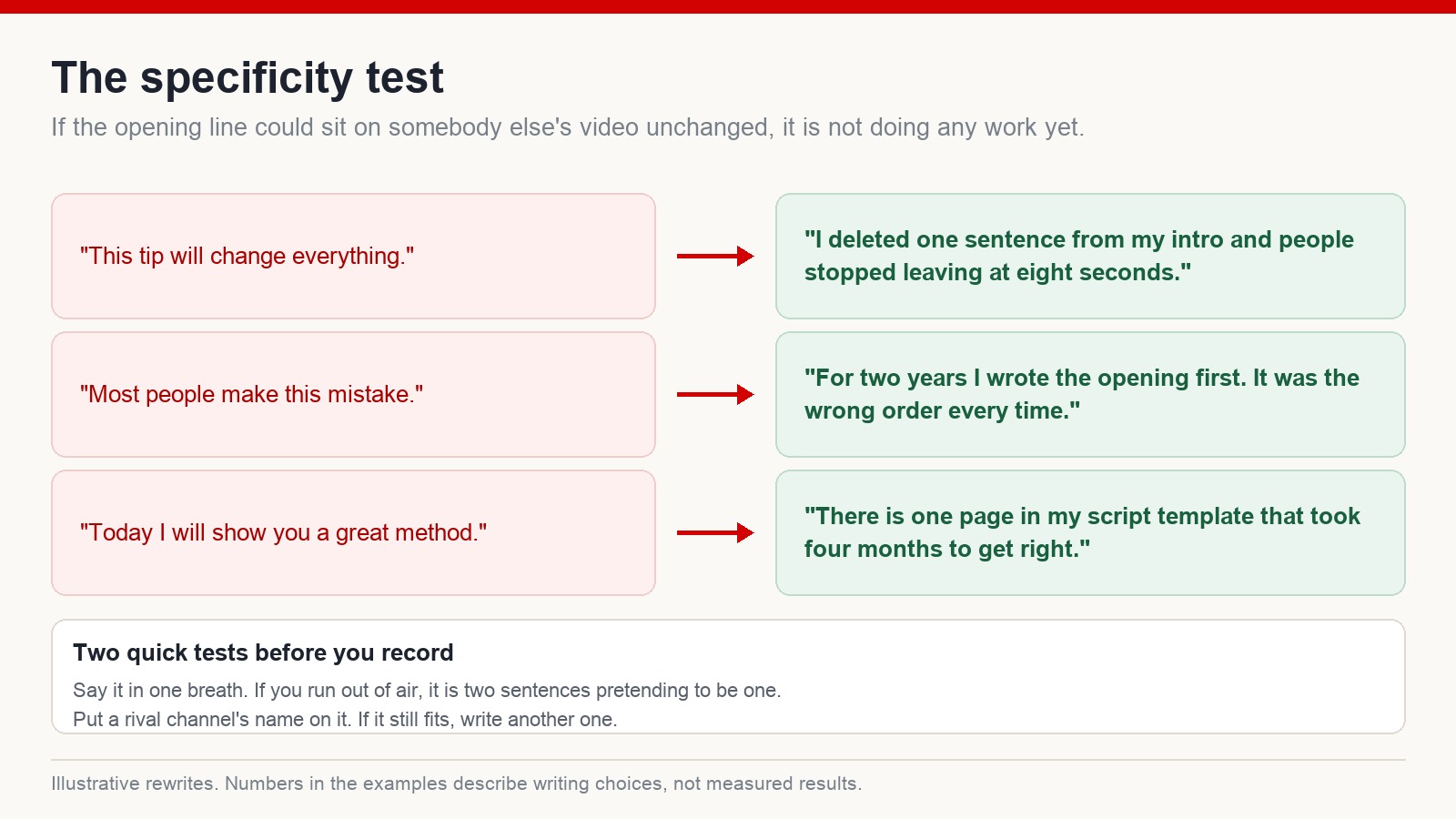
Two tests before you record
Say it in one breath. If you run out of air, it is two sentences pretending to be one, and the spoken version will lose its shape. Openings are heard, not read, and a line that looks fine on a page can be unrecordable.
Then put a rival channel’s name on it. If the line would work just as well on their video, write another one. What survives that test is usually the sentence that contains something only you can say.
Do not answer it in the next sentence
A strong first line dies most often in the second line. You open a gap, the silence feels uncomfortable, and you immediately explain — which closes the loop you just opened and hands the viewer permission to leave.
The fix is mechanical. After your chosen opening, the next sentence should move toward the answer, not arrive at it. Set the scene, raise the stakes, add a complication. The payoff comes later, and it does have to come; an opening that never resolves is the thing everybody rightly hates.
What the graph can tell you afterwards
After publishing, look at the retention curve in the opening seconds — but read it carefully. A drop at the start is normal on every video ever made, so the number on its own means nothing.
What is worth looking at is the comparison with your own recent videos. If this one falls away noticeably faster than your own median in the first stretch, the opening is a reasonable suspect. If it holds better, whatever you did there is worth repeating. Compare against yourself rather than against a benchmark from a blog post; the useful signal is relative, and every niche behaves differently.
And be honest about what the graph cannot tell you. It will not separate a weak opening from a mismatched thumbnail, or from an audience that came expecting something else. It is a prompt to look, not a verdict.
Three ways a strong opening still fails
It promises more than the video delivers. The most damaging failure, because it works: people stay, then discover the video is not what they were told. They leave mid-way, and that is a worse signal than never clicking.
It is too complicated. A line with two clauses and a subordinate idea reads well and lands badly. Openings need to be understood at speed, by someone half-paying attention.
It borrows urgency it has not earned. Manufactured stakes in the first line are audible. If the subject genuinely matters, say the true version of why; if it does not, choose curiosity over drama.
A ten-minute drill
Open your last three videos and write down the first sentence of each, exactly as recorded. Read them one after another. Then rewrite each one twice: once to make it more specific, once to remove everything except the part that creates the gap.
Most people find the same weakness repeated three times, which is more useful than any list of hook types. Fix that one habit and the next video starts better than the last three did.
Frequently asked questions
How long should the first sentence be?
Short enough to say in one breath. Length matters less than whether it can be understood at speed by someone who is not concentrating.
Should I write the opening first or last?
Draft candidates first so the video has a direction, then choose the final version once the video is finished and you know what it actually delivers.
How do I know which of my five lines to record?
Take the one that is most specific to your video and least usable on anyone else’s. If two are close, record both and listen back; spoken delivery separates them quickly.
Is a question a good opening?
It can be, if the question is one the audience is actually asking. A generic question is just a vague claim with punctuation.
Does the opening matter as much for short videos?
More, if anything. There is less runway, so the first line often has to carry the gap and the subject at the same time.
If you want the full process for building a faceless channel aimed at English-speaking audiences, that is what I teach at mmoyoutube.com.